
Table of Contents
ToggleIntroduction
Potholes, standing water, winter damage, and heavy traffic can quickly create safety and access problems for your tenants, customers, and deliveries. With asphalt paving Edmonton projects, you need more than a fresh surface. Base preparation, grading, drainage, materials, compaction, and traffic loads all affect how well your pavement performs through Alberta’s freeze-thaw cycles.
The right plan also protects daily operations. An experienced contractor can coordinate excavation, base repair, paving, repairs, safety measures, and traffic phasing while maintaining access to active commercial, industrial, retail, and multi-tenant properties. This guide covers paving applications, site planning, the construction process, Alberta-specific conditions, cost factors, and maintenance requirements, including when repairs, resurfacing, or full replacement make sense.
With over 25 years of combined experience, U-PAVE provides complete paving and site preparation services throughout Edmonton, Greater Edmonton, and Central Alberta. Schedule a Site Visit to assess your property.
Key Takeaways
- Commercial asphalt performance depends on proper excavation, base preparation, grading, drainage, asphalt placement, and compaction.
- The right solution may be asphalt repair, resurfacing, an overlay, milling and replacement, or full reconstruction, depending on pavement and base conditions.
- Commercial paving projects should account for heavy traffic, loading areas, tenant access, pedestrian safety, deliveries, and phased construction.
- Edmonton’s freeze-thaw cycles, spring moisture, snow removal, and de-icing can accelerate pavement damage when drainage and base conditions are poor.
- Regular inspections, crack sealing, pothole repairs, drainage maintenance, line painting, and seasonal care help protect commercial asphalt over time.
Quick Answer
How long does a commercial asphalt paving project take in Edmonton?
The timeline depends on site size, pavement condition, excavation requirements, weather, traffic control, material availability, inspections, and hidden base problems. Small repairs may be completed quickly, while resurfacing and full reconstruction require more planning. Schedule a Site Visit for a project-specific scope and schedule.
Asphalt Paving Edmonton for Commercial Properties: What You Need to Know
Commercial asphalt paving must support daily business operations, not just improve appearance. Your pavement needs the right base, drainage, asphalt thickness, grading, compaction, and traffic plan for the property. A retail parking lot has different requirements than a truck yard or warehouse entrance.
U-PAVE provides commercial asphalt paving services throughout Edmonton, Greater Edmonton, and Central Alberta. With more than 25 years of combined paving, site preparation, and construction experience, our team plans each project around site conditions and operational needs.
Where Commercial and Industrial Asphalt Is Used
Commercial and industrial asphalt is used wherever vehicles, deliveries, equipment, and pedestrians share a property. Common applications include:
Parking lots for retail plazas, shopping centers, schools, institutions, and office complexes.
Access roads connecting commercial buildings, warehouses, and industrial facilities.
Warehouse entrances, loading docks, and delivery lanes that receive repeated heavy vehicle traffic.
Truck yards, fleet yards, logistics areas, and heavy equipment yards.
New commercial developments requiring complete excavation, grading, base construction, and paving.
Traffic patterns affect every part of the design. Frequent turning movements place more stress on the surface than vehicles traveling straight. Delivery schedules can increase the number of heavy axle loads, while semi-trailers and equipment require stronger pavement and properly prepared base materials.
Pedestrian activity also affects the project. Your plan may need safe walkways, clear access routes, proper grades, drainage control, and construction phasing that protects customers, tenants, staff, and visitors. Work at an active shopping center or warehouse often needs staged closures instead of a full shutdown.
The Pavement Problems a Well-Planned Project Can Solve
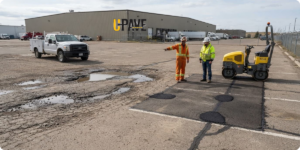
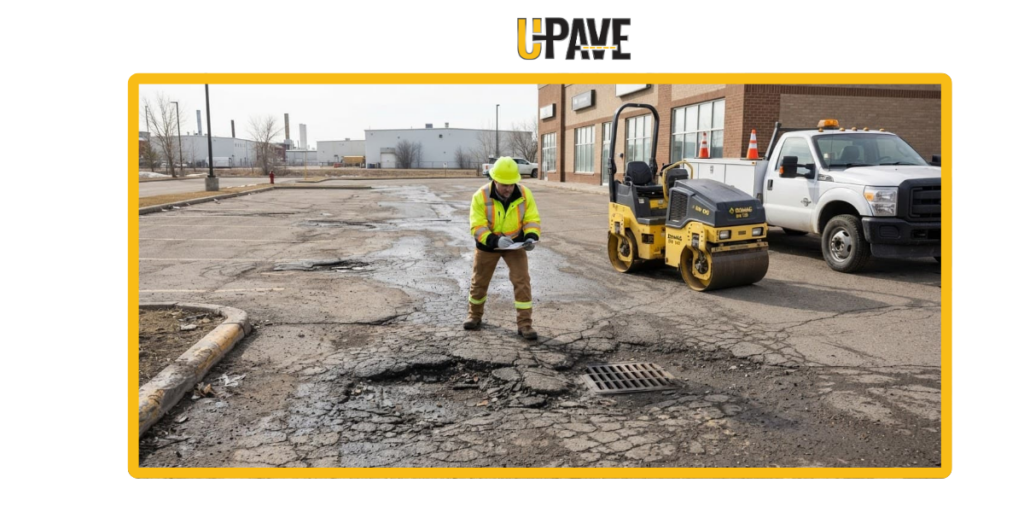
Potholes, wide cracks, rutting, sinking areas, uneven pavement, standing water, and weak edges are visible signs of pavement distress. The visible damage, however, may not be the actual cause.
Poor drainage can leave water under the asphalt. A weak subgrade, inadequate compaction, or failing gravel base can cause settlement and recurring cracks. Heavy traffic can then accelerate the failure, especially around loading areas, turning lanes, and pavement edges.
A thin surface patch may improve appearance for a short time, but it won’t correct structural problems below the surface. Depending on the condition, the right solution may include targeted patching, regrading, drainage correction, full-depth asphalt repair, milling and replacement, resurfacing, or a new pavement system.
If failures keep returning, an asphalt parking lot assessment can help clarify why drainage, subgrade condition, and pavement slope matter before repair work begins.
Plan Your Paving Project Around Traffic, Access, and Site Conditions
Commercial asphalt paving starts before the paver arrives. Your contractor should inspect the existing pavement, review grades and drainage, understand traffic loads, identify utilities, and plan around tenants, customers, deliveries, emergency access, and employee parking. A site visit helps determine whether your property needs repairs, resurfacing, an overlay, or full reconstruction.
How Base Preparation Affects Asphalt Performance
Asphalt depends on the ground below it. Excavation removes unsuitable material and allows the crew to prepare a stable subgrade. The subgrade must be shaped, moisture-controlled, and compacted before gravel base materials are placed.
The gravel base spreads vehicle loads and provides a stable layer below the asphalt. Proper grading directs water away from the pavement, while careful compaction reduces settlement, rutting, and recurring cracks. If the soil below is weak or remains loose, the asphalt may fail even when the surface installation looks correct.
Depending on the site assessment, cement stabilization may help strengthen unsuitable subgrade conditions. The recommended method should match the soil, moisture, traffic demands, and overall project design. U-PAVE provides gravel base preparation and site work as part of complete commercial paving solutions.
Drainage, Slopes, and Alberta Freeze-Thaw Conditions
Standing water creates problems below the surface. It enters cracks, saturates the base, and weakens supporting soil. When temperatures fall, trapped moisture can freeze and expand. During spring thaw, the softened ground may deform under traffic.
Edmonton’s changing temperatures, snow, ice, and spring thaw make drainage and base design especially important. The plan may include corrected grading, drainage improvements, catch basins, or other measures that direct water away from driving lanes, buildings, and parking areas.
Pavement design should account for seasonal ground movement and heavy use. Research on cold-region pavement performance also identifies frost heave and thaw weakening as major causes of pavement deformation, as described in this frost action research.
Keep Your Business Operating During Construction
Active commercial and industrial sites need a traffic plan before work begins. Phased paving can keep part of a parking lot, truck yard, or access road open while another section is closed.
Your contractor may coordinate:
Temporary traffic routes and section-by-section closures.
Off-peak work around deliveries and customer traffic.
Clear notices for tenants, employees, and visitors.
Safe pedestrian paths and protected work areas.
Emergency access for the property and surrounding routes.
For larger commercial or industrial projects, Schedule a Site Visit so the scope and access plan reflect your actual site conditions.
What Happens During a Commercial Asphalt Paving Project
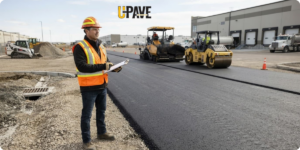
Commercial asphalt paving in Edmonton follows a planned sequence. Your contractor must address the ground below the pavement, traffic demands, drainage, access, and finishing details before the site reopens.
Assessment, Scope, and Project Planning
The process starts with a site review. The contractor checks pavement condition, measurements, traffic patterns, grades, drainage, access points, utilities, and previous repair areas. Heavy truck routes, turning lanes, loading docks, and pedestrian paths all affect the recommended solution.
Your written scope should identify quantities, excavation and base work, asphalt depth or treatment, drainage improvements, catch basin work, line painting, cleanup, phasing, and exclusions. Compare complete scopes instead of choosing only the lowest initial price. A lower quote may not include the same level of base repair or finishing work.
Reviewing commercial paving project examples can also help you understand the contractor’s experience with active commercial and industrial sites.
Excavation, Grading, and Base Construction
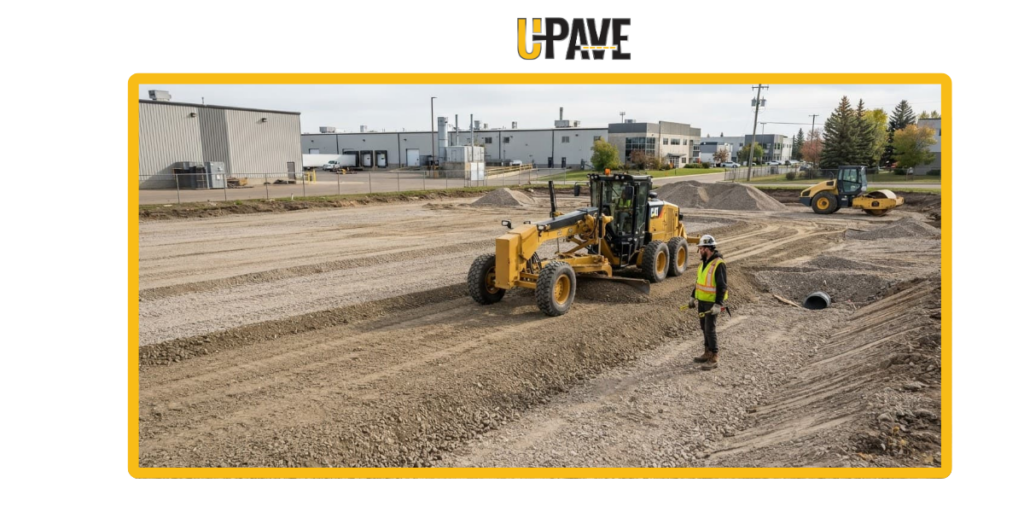
Crews remove failed asphalt and unsuitable material before correcting the subgrade. The exposed area is shaped, moisture is managed, and aggregate is placed in the required layers. Each layer must receive proper compaction before the next stage begins.
This work often determines how the finished pavement performs under commercial traffic. Weak or wet areas may require deeper reconstruction, additional aggregate, or cement stabilization. Proper grading also directs water away from the pavement and nearby buildings.
Asphalt Placement, Compaction, and Finishing
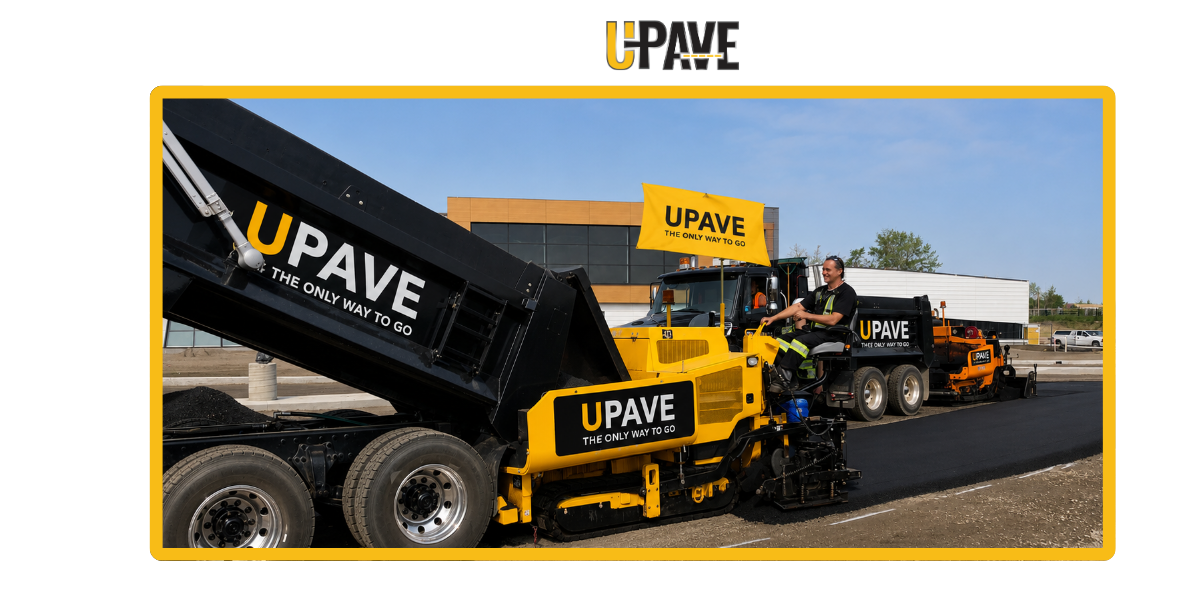
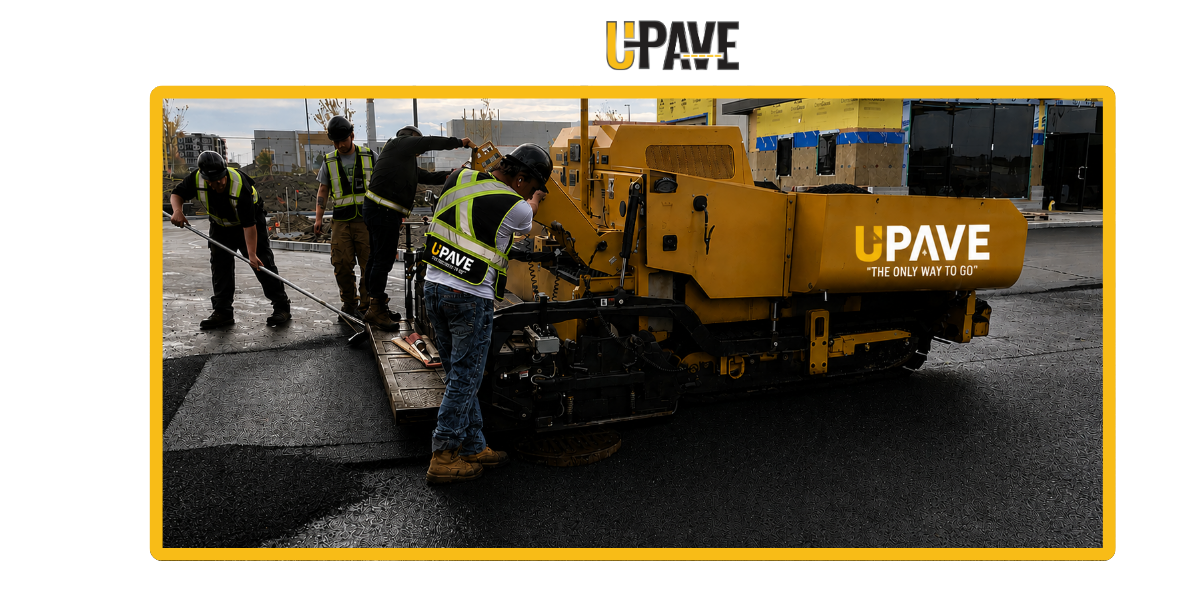
After preparation, the crew cleans the surface and applies tack where needed to improve bonding. Hot-mix asphalt is placed with a paver, then compacted while it remains workable. Asphalt Institute engineering guidance explains how materials, pavement design, and installation details affect performance.
The crew checks thickness, smoothness, joints, tie-ins, edges, and transitions. The scope may also include catch basin adjustments, accessible routes, pavement markings, parking blocks, and speed bumps.
Timeline, Curing, and Reopening the Site
A small repair takes less time than parking lot resurfacing or full-site reconstruction. Weather, temperature, site size, traffic control, material availability, inspections, and hidden base problems can change the schedule.
Your contractor should provide reopening guidance based on the asphalt mix, weather, and completed work. There isn’t one universal waiting period. After final cleanup and handover, Request a Free Quote for a commercial paving plan based on your property.
How Edmonton Weather and Heavy Traffic Change Your Paving Decisions
Edmonton pavement must handle repeated freeze-thaw movement, snowplow activity, de-icing materials, spring moisture, summer heat, and heavy commercial traffic. These conditions affect the pavement structure, materials, construction schedule, and maintenance plan.
A customer parking lot doesn’t need the same design as a truck yard, loading dock, or equipment yard. Your contractor needs to understand how the property operates before recommending a paving solution.
Match the Pavement Design to Traffic and Operations
Delivery frequency, axle weight, and vehicle movement all affect pavement performance. Heavy trucks create greater stress than customer vehicles, especially where trailers turn slowly, follow concentrated wheel paths, idle, or brake near a dock.
Truck yards, warehouse access roads, loading areas, and industrial facilities may require stronger base preparation, additional structural support, durable edges, and materials suited to repeated heavy use. Summer heat can soften asphalt under slow-moving loads, while winter plowing and de-icing products can accelerate surface wear.
Share your current and expected traffic information with the contractor, including:
Daily delivery volume and vehicle types.
Heavy axle loads and trailer dimensions.
Turning, braking, and idling locations.
Areas planned for future expansion or increased use.
Proper grading and drainage corrections remain important when spring moisture threatens the supporting layers. Modern pavers, rollers, and experienced crews support consistent placement and compaction, but equipment cannot correct a weak design or poorly
Protect Safety, Access, and Compliance
Safety planning belongs in the paving scope from the start. Work-zone separation, pedestrian routing, visibility, accessible parking, fire routes, drainage openings, temporary signage, and tenant communication all require coordination.
Your contractor should identify safe access for customers, staff, deliveries, emergency vehicles, and facility users before work begins. Accessible routes and clear markings also need protection during each construction phase. Federal guidance on accessible sidewalk and trail design highlights the importance of access, signage, and traffic control.
Phased construction can keep essential areas open while crews work elsewhere. To plan the right paving, traffic, and safety approach, Request a Free Quote.
Commercial Asphalt Paving Cost in Edmonton: What Affects Your Budget
Commercial asphalt paving costs in Edmonton depend on more than the visible surface area. Square footage, excavation depth, base condition, asphalt thickness, drainage, trucking, disposal, access, and traffic control all affect the final estimate.
A low surface-only quote may look attractive, but it may not address the cause of cracking, rutting, settlement, or standing water. A site assessment and written scope are needed for a reliable comparison.
Repair, Overlay, or Full Replacement?
The right option depends on inspection findings, pavement condition, drainage, and traffic demands.
Approach | When it may make sense |
|---|---|
Patching or infrared repair | Localized potholes, cracks, or isolated surface damage with a stable base. |
Overlay or resurfacing | Moderate surface wear when the existing pavement and drainage remain structurally sound. |
Milling and replacement | Worn or uneven asphalt where removing the failed surface provides a better bond and finished grade. |
Full reconstruction | Widespread base failure, deep settlement, poor drainage, or weak subgrade requiring excavation, stabilization, and replacement. |
Costs may also include grading, catch basins, curbs, aggregate placement, compaction, line painting, phasing, and cleanup. For budgeting, parking lot repair cost Edmonton estimates are only useful when the scope identifies the repair depth and underlying conditions. Federal pavement preservation guidance also distinguishes surface treatments, overlays, and structural rehabilitation based on pavement condition, not appearance alone.
Questions to Ask Before Accepting a Quote
Ask whether the written scope includes:
Base preparation, excavation depth, soil stabilization, asphalt specifications, and compaction requirements.
Grading, drainage corrections, curbs, catch basins, and tie-ins to existing pavement.
Aggregate quantities, trucking, disposal, cleanup, line painting, and traffic control.
Phasing, tenant access, schedule risks, weather delays, and reopening requirements.
Warranty terms, change-order rates, exclusions, permits, and coordination with utilities or other contractors.
Request measurable work items and clear assumptions. A detailed scope makes competing quotes easier to compare and reduces surprises during construction. For a property-specific recommendation, Schedule a Site Visit.
Extend the Life of Your Commercial Pavement After Paving
A new asphalt surface needs regular care to perform through Edmonton’s freeze-thaw cycles, snow removal, de-icing, and commercial traffic. Inspection, prompt repairs, drainage upkeep, crack sealing, sweeping, and seasonal maintenance help protect your paving investment and reduce avoidable disruption.
Build a Maintenance Schedule for Edmonton Conditions
Inspect your parking lot or industrial yard after winter and following major storms. Look for potholes, open cracks, ponding, damaged edges, blocked catch basins, and areas affected by snowplows. Address potholes and drainage issues promptly before water reaches the base and causes wider failure.
Seal cracks while they remain manageable. Crack sealing slows water entry, but it won’t correct a weakened base or widespread structural damage. Sealcoating may also help protect suitable asphalt from oxidation and surface wear, based on pavement condition and traffic demands.
Refresh parking lot markings, accessible spaces, traffic arrows, and loading-area markings as they fade. Regular sweeping removes debris that can block drainage and wear the surface. Snow clearing and ice management should also limit scraping damage while maintaining safe access.
Heavy-use sites, truck yards, loading docks, and warehouse entrances may need more frequent reviews than lightly used parking lots. A preventive asphalt maintenance program can organize inspections and scheduled work around your operating calendar.
Know When Recurring Repairs Point to a Larger Failure
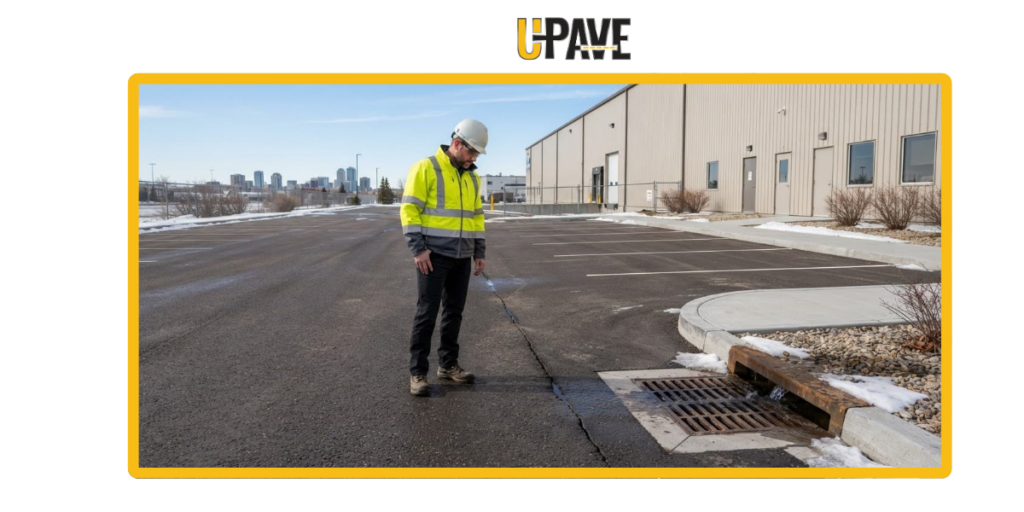
Recurring potholes, widening cracks, soft spots, rutting, ponding, edge breakup, and settlement near catch basins or loading areas indicate more than normal surface wear. Repairs that fail repeatedly may point to drainage problems, weak subgrade, poor compaction, or base failure.
Maintenance can slow deterioration, but it cannot replace failed pavement structure.
Use parking lot asset planning and lifecycle budgeting to schedule larger repairs before an emergency affects tenants, deliveries, customer access, or safety. When pavement problems become frequent, Request an Asphalt Assessment to review the condition and plan the right repair, resurfacing, or reconstruction approach. For a project estimate, Request a Free Quote.
Frequently Asked Questions About Commercial Asphalt Paving in Edmonton
How much does commercial asphalt paving cost in Edmonton?
Commercial asphalt paving costs depend on project size, excavation depth, asphalt thickness, base condition, drainage work, trucking, disposal, access, and traffic control. A site assessment and detailed written scope are needed to compare estimates accurately.
Can paving be completed without closing an active business?
Many commercial paving projects can be completed in phases to maintain access for tenants, customers, employees, deliveries, and emergency vehicles. The construction plan should include temporary traffic routes, section-by-section closures, pedestrian paths, and communication with site users.
How does drainage affect commercial asphalt performance?
Standing water can enter cracks, saturate the base, and weaken the supporting soil. Edmonton’s freeze-thaw cycles can then cause additional movement, settlement, and pavement failure. Grading, catch basin work, drainage correction, and base repairs may be required before new asphalt is installed.
How do I know whether my asphalt needs repair or replacement?
Localized damage with a stable base may be suitable for patching or infrared repair. Widespread settlement, recurring potholes, poor drainage, rutting, or weak subgrade conditions may require milling, resurfacing, or full reconstruction. Request an Asphalt Assessment to review the pavement and determine the appropriate solution.
How does drainage affect commercial asphalt performance?
Standing water can enter cracks, saturate the base, and weaken the supporting soil. Edmonton’s freeze-thaw cycles can then cause additional movement, settlement, and pavement failure. Grading, catch basin work, drainage correction, and base repairs may be required before new asphalt is installed.
Can UPAVE LTD help with base preparation before paving?
Do you provide paving outside Edmonton?
Yes. UPAVE LTD serves Edmonton, Greater Edmonton, Central Alberta, and surrounding areas. Remote and Northern Alberta projects may be considered upon request, depending on planning, trucking, suppliers, accommodations, and disposal requirements.
Conclusion
Your commercial paving decisions should match the pavement to traffic loads, investigate the base and drainage, and protect access throughout construction. Phased work, clear safety planning, and a complete written scope help you compare quotes accurately while keeping tenants, customers, deliveries, and facility operations moving.
U-PAVE brings over 25 years of combined commercial and industrial experience to Edmonton, Greater Edmonton, and Central Alberta. You receive an Alberta-focused approach, modern equipment, transparent communication, and one contractor for paving, repairs, excavation, grading, maintenance, and seasonal services. Proper planning and ongoing care support better long-term pavement performance.
Whether you manage a retail plaza, warehouse, industrial yard, school, development, or multi-tenant property, Request a Free Quote for a project estimate or site assessment. The right paving plan protects your property, your operations, and your maintenance budget.